UK Manufacturing
UK Fashion Manufacturing: Manchester Event Charts Path Forward
Industry leaders gathered in Manchester to discuss reviving UK garment production, from public procurement to overcoming MOQ barriers and building regional supply chains.

Manchester event shines spotlight on domestic production
The future of UK fashion manufacturing was under the microscope in Manchester last week as manufacturers, retailers, emerging brands and industry bodies came together to explore how domestic production can become a more commercially viable option. Held at Manchester Hall on 4 November, the event was organised by Source Fashion, Fashion-Enter Ltd and the Apparel & Textile Manufacturers Federation (ATMF), building on the Leicester Made & Regions showcase earlier in 2026. The move to Manchester signals a broader ambition to link manufacturing hubs across the UK, raise the visibility of regional capabilities and encourage brands to rethink where and how their products are made.
The initiative directly addresses the disconnect between what British manufacturers can offer and what businesses looking to source production actually need. While rising global sourcing costs, geopolitical uncertainty and supply chain disruption have renewed interest in nearshoring and reshoring, domestic manufacturers still struggle to secure the consistent orders that would allow them to sustain and invest in their operations.
For Suzanne Ellingham, event director of Source Fashion, bringing the different sides of the industry together was the primary motivation. She said: “Through Source Fashion, we talk a lot about the need to connect ecosystems and just how many great businesses there are in the UK and further afield. If nobody knows about them, then nothing’s going to move forward.”
Ellingham added that there is a “need to move beyond talking about its potential and focus on the practical steps that will make a difference”. “That means bringing manufacturers, brands, retailers and policymakers together to address the commercial challenges facing the sector and identify where meaningful progress can be made. Manchester Made & Regions is about building momentum, creating stronger connections across the industry and ensuring the conversations we are having lead to tangible action,” she continued.
The event combined an exhibition floor with a conference programme, giving visitors the chance to meet manufacturers and suppliers directly while hearing from industry figures about the commercial, political and practical considerations involved in rebuilding domestic production.
Reindustrialisation demands more than factory capacity
The first discussion of the day asked whether the UK could reindustrialise its fashion and textile sector. Chaired by Jenny Holloway, chief executive officer of Fashion-Enter Ltd and chair of the ATMF, the panel included manufacturing representatives and education leaders. The conversation laid bare the scale of the industry’s decline, the loss of specialist skills and the difficulties factories face in securing enough work to remain operational.
Public procurement emerged as a particularly important opportunity. Speakers questioned why more publicly funded contracts — including military and NHS uniforms — are not being directed towards domestic manufacturers. A video address from Kevin McKeever, chair of the Garment and Textile Workers’ Trust, stressed the urgency: he stated that more than 14,000 garment jobs had disappeared since 2020 and argued that public money should be used to support domestic employment and production.
The discussion also explored how government contracts could be distributed more effectively. Holloway highlighted work underway to bring 20 factories together in a consortium to bid for larger public sector contracts, potentially providing a more accessible route into procurement for smaller manufacturers.
However, speakers stressed that investment in factories alone would not be enough. Skills development, training, transport infrastructure and closer relationships between manufacturers and educational institutions were also flagged as necessary for a functioning domestic supply chain. The debate underlined that skills and machinery still exist in parts of the UK, but manufacturers need a more reliable flow of business to retain workers, invest in equipment and plan production.
This was also a central theme of the later discussion on what local ecosystems need to thrive, which explored how regional ecosystems could become more visible and commercially connected. In the panel, named ‘Harnessing Local Capabilities’, Gemma Gratten, co-founder of Manchester Fashion Week and the Northern Fashion Collective, highlighted the importance of strengthening regional networks, supporting emerging talent and creating accessible pathways into manufacturing careers.
Technology also featured, with Nicholas Betts, founder of AI pattern cutting tech firm Zerotec, outlining how digital solutions could improve material efficiency, reduce waste and help bring down the cost of local production. The latter is particularly relevant to nearshoring, where higher manufacturing costs continue to be a significant barrier for brands considering a move away from overseas suppliers.
Patrick Grant makes the economic case for British production
The commercial realities of domestic manufacturing were explored further by Patrick Grant, founder of Community Clothing and judge on the BBC’s The Great British Sewing Bee, whose business works with 59 partner factories across the UK. Grant and his brand served as an example of how a business can support domestic production through long-term supplier relationships, predictable ordering and a permanent product range, rather than relying solely on the traditional seasonal fashion calendar.
Community Clothing’s approach is built around giving factories more consistent work throughout the year, while removing some of the conventional retail, marketing and supply chain costs that can raise the price of British-made products. He also challenged the widely held perception that UK manufacturing is inherently too expensive to compete with overseas production, arguing that greater production volumes would improve factory efficiencies and ultimately reduce costs.
“Everybody always says that the UK is an expensive place to manufacture. And right now, with the industry as it is, it is expensive, but it’s good. But if it were twice the size or three times the size, it would get a lot less expensive because the efficiencies in those factories, both operating efficiencies and overhead efficiencies, would start to come down dramatically,” Grant said.
The example demonstrated why securing larger and more consistent orders is so important to the future of British production. Grant also highlighted that 95 pence of every pound spent with Community Clothing returns to the UK economy, reinforcing the wider economic contribution that domestic sourcing can make.
Grant’s participation reflected the growing prominence of the conversation around UK manufacturing. Bringing in a well-established advocate of domestic production only emphasised the growing importance and renewed interest in practical commercial opportunities.
MOQs remain a sticking point
Away from the conference programme, discussions on the exhibition floor painted a picture of some of the challenges facing businesses. Minimum order quantities (MOQs) were among frequently raised concerns, particularly for start-ups and smaller brands that may not have the demand or financial capacity to commit to larger production runs.
However, Ellingham suggested that the terminology itself could be contributing to a misunderstanding between manufacturers and prospective customers. “What we actually need to start thinking about is what’s the optimal order quantity for that manufacturer,” she said. “The great thing about connecting local ecosystems is that actually chances are there’s something on your doorstep that can do those small volumes. We see that especially with British manufacturers. They will go down to those lower orders because realistically if brands have durable products that their customers love, they’re coming back for a repeat order and that’s a growing brand. There’s an opportunity here for all these manufacturers to nurture some of those brands.”
She explained that different manufacturers have different production thresholds, depending on their equipment, materials and operating costs. The challenge is establishing the point at which an order becomes commercially viable for both parties.
This was reflected in conversations with exhibitors. Leicester-based All She Wants Clothing, which specialises in ladies’ occasionwear and supports businesses with design, sampling and production, said it had received considerable interest around smaller production runs. “We’ve had a really mixed room, so it’s been really nice to talk to different people,” a representative said. “MOQ needs to be a continuous question. Whether we can accommodate a very small MOQ, that’s come up a lot. And then the price point, I think, is fairly standard.”
The manufacturer, which had previously exhibited at Leicester Made & Regions earlier in the year and attended the Manchester edition to reach a potentially different audience, said it typically works with orders starting at around 50 units, depending on the style and whether the required fabric is readily available. It also works with start-ups, offering design services to support businesses at earlier stages of development.
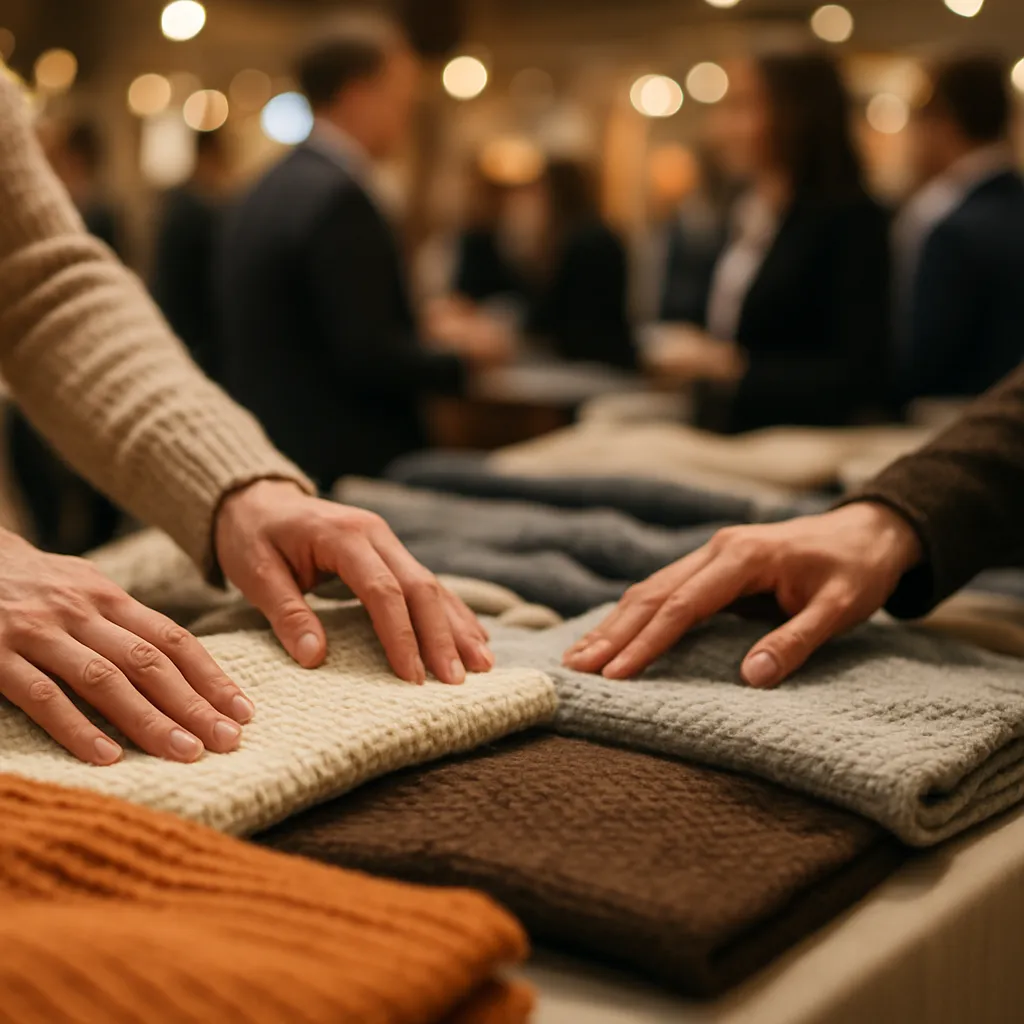
Leicester-based knitwear manufacturer 23Foxes, which also participated in Leicester Made, similarly sought the opportunity to meet prospective customers in person. The family-run business, which has operated since 1987, has a particular focus on natural fibres and recycled yarns. For its representative, face-to-face interaction remains one of the main reasons to attend sourcing events. “It’s easy to just have a conversation. Seeing people face-to-face is completely different. People don’t just get to see our stuff, they’ve got to touch it,” the exhibitor explained. “Fashion is very face-to-face. You’ve got to enjoy who you do business with.”
The representative also welcomed the opportunity to attend an event in the North of England, noting that other industry showcases are often concentrated in London. Price, however, remains a considerable obstacle. “People are saying to me that they’re looking for a cheap price. You can’t typically expect that in the UK,” they added, highlighting the need for brands to understand the value of domestic production beyond unit cost alone.
A diverse audience seeks new connections
The exhibition also drew in businesses beyond the manufacturing community, demonstrating the wider commercial relationships that regional sourcing events can facilitate. Among those exhibiting was the founder of Liverpool-based fashion brand Lola Starr, who was looking to connect with potential stockists rather than seeking a manufacturing partner. The founder reported encountering several businesses interested in finding UK manufacturers and highlighted the potential economic benefits of developing stronger regional manufacturing networks, particularly in Liverpool. “I always say it in Liverpool because we’ve got that many brands in Liverpool. If we were all making it in Liverpool, imagine the jobs you create.”
Alongside independent brands and manufacturers, the event brought together buyers, retailers, sourcing teams, technology providers and industry organisations. For Ellingham, the diversity of the audience was evidence that the event had achieved its objective. “What we’ve seen today is a real mix of buyers and brands, retailers, tech providers and manufacturers, and there’s definitely been some fantastic connections made,” she said.
From Manchester to Scotland: what comes next?
For the organisers, Manchester Made & Regions is intended to become part of a broader regional programme, not just a one-off event. Ellingham confirmed that the Manchester edition had been successful enough to warrant a return, with organisers already considering additional locations to bring the format to businesses outside the traditional London sourcing network. “Made in Manchester was our first opportunity to really bring together our northern base of buyers with some really fantastic businesses and put together a content programme that really talks to the issues around why aren’t we prioritising manufacturing,” she said. “It’s important we have those conversations because until we have those conversations and people hear them, we don’t necessarily realise that everyone’s thinking the same. So for us I think our objectives have been met.”
Ellingham added that there were definitely plans to host a similar event next year, with Scotland having already been identified as the potential next destination, with an event planned for the first quarter of 2027. “We’ve also been looking at Yorkshire and the South East,” she added. The discussions and connections established in Manchester will also feed into the next edition of Source Fashion, which takes place at ExCeL London from 19 to 21 January 2027.