Rimowa
Rimowa and Maison Margiela's Bianchetto Travel Set
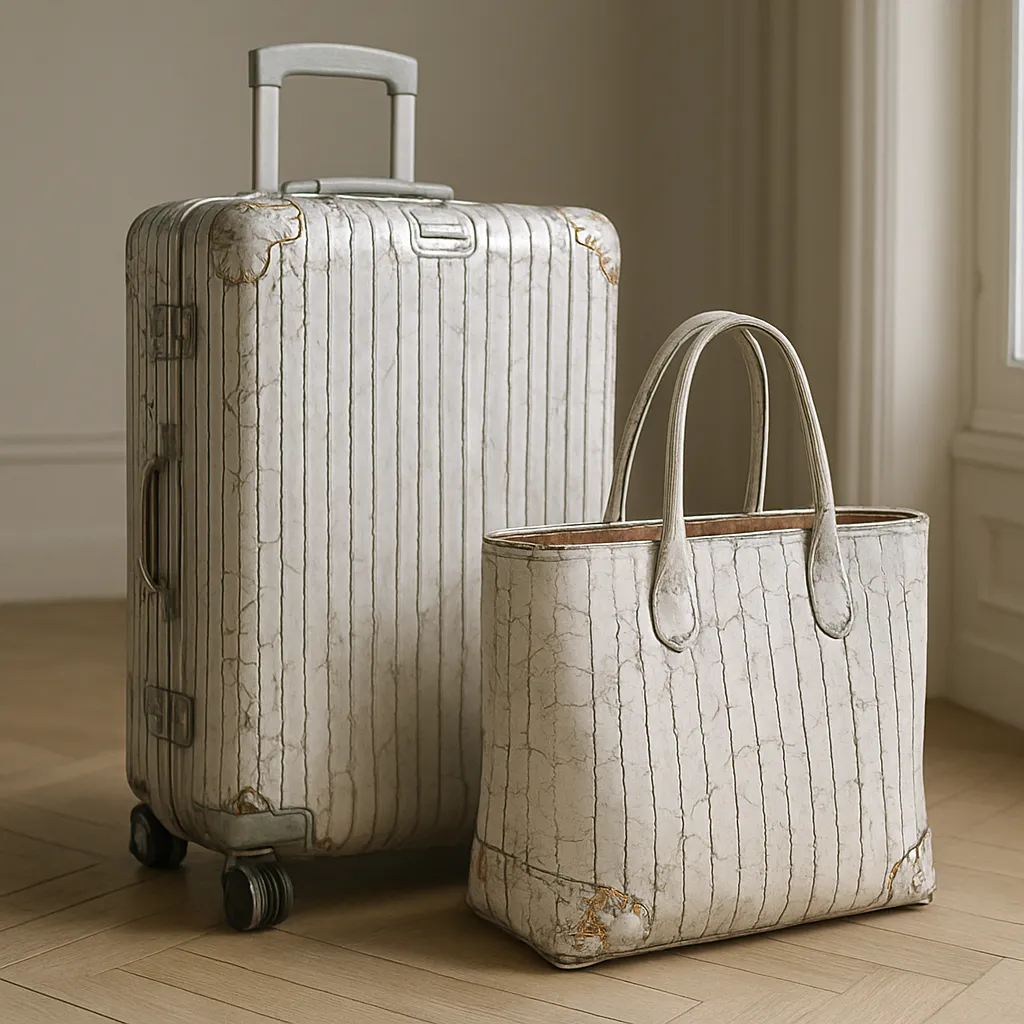
Rimowa and Maison Margiela release a limited-edition travel set pairing the Classic Cabin suitcase with the 5AC XL bag, hand-painted in signature Bianchetto.
Two houses, one travel set
A German luggage maker known for its grooved aluminium shells and a Parisian couture house famous for deconstruction have pooled their design languages into a single travel set. The limited-edition release pairs the Rimowa Classic Cabin suitcase with the Maison Margiela 5AC XL bag, sold together as a coordinated pair rather than as separate accessories.
Both pieces go on sale from 19 November 2026 at selected Rimowa and Maison Margiela boutiques, and through both brands’ own websites. Availability is limited.
Wear and tear as the starting point
The idea behind the set is a shared fascination with objects that record their own history. A well-travelled aluminium case collects dents, scuffs and a dulled sheen that no two owners will reproduce in the same way. Maison Margiela has long treated those traces as valid design material in their own right — garments are reclaimed, kept and deliberately aged so that time becomes part of the object.
Bringing the two together meant carrying a single motif between the pieces. Rimowa’s parallel grooves travel from the hard shell of the suitcase onto the softer body of the bag, so the pair reads as one object divided in two.
On top of that, both items are hand-painted in Bianchetto, Maison Margiela’s signature white overpainting treatment. Because the paint is applied by hand, it begins to crack and flake from the first journey onwards. Each suitcase and each bag will therefore distress differently, developing a personal patina rather than fading into anonymity.
Where the two signatures come from
Neither detail is new. Rimowa introduced its aviation-inspired grooves on an aluminium suitcase in 1950, and they have remained the house’s most recognisable marker since. Bianchetto has its own origin story: in 1988, founder Martin Margiela painted all the furniture in the label’s first design studio white, and the technique has since become a recurring gesture in the house’s work.
Construction turned outward
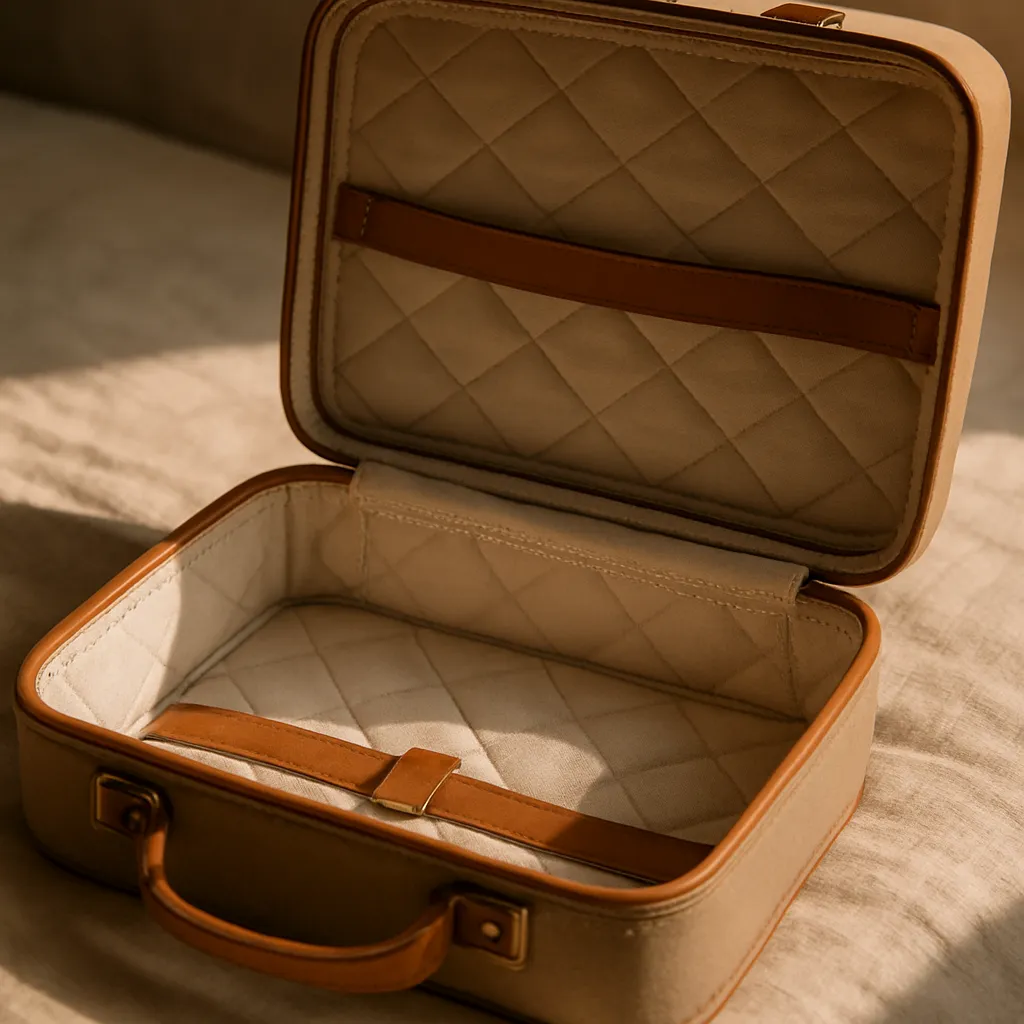
Open the Classic Cabin and the interior does not behave like a conventional suitcase. A white lining is combined with leather details, visible stitching and overlocked edges, deliberately giving the inside an unfinished, inside-out character. It is a direct nod to Maison Margiela’s approach to garment-making, where linings and internal construction are exposed rather than hidden. The same logic appears on the 5AC, whose lining extends beyond the edge of its leather body.
Small details reinforce the exchange. The aluminium logo badge on the suitcase is finished with four slanted white-thread stitches.
The suitcase
- Anodised aluminium, made at Rimowa’s factory in Cologne, Germany
- Grooved shell with a stage-free telescopic handle
- Multiwheel system for four-wheel manoeuvring
- TSA-approved locks
The bag
- Grooves formed directly into the leather using a high-frequency technique, with no needle or thread
- Cross-body leather strap included
- Removable leather loops that attach the bag to the top of the Classic Cabin, aligning the grooves of both pieces
Each item also comes with a leather tag that merges Rimowa’s address tag with Maison Margiela’s key bell — a small object that signals the partnership without shouting about it.
A campaign built on paint
The launch imagery was directed and photographed by Dexter Lander. Shot inside a Haussmannian apartment, it stages the Bianchetto application as a spectacle, with white paint sprinkled across the Classic Cabin, the 5AC and the room itself. When the pieces are lifted away, their silhouettes remain imprinted on the wall behind — a neat visual summary of an idea the collection is built on: that an object’s marks are as valuable as its surface.
Who it is for
This is not a set aimed at the occasional weekender. It will appeal to collectors of both houses, to travellers who like their luggage to look lived-in rather than showroom-fresh, and to anyone drawn to the tension between a spotless anodised shell and a finish designed to deteriorate. The pairing of hard cabin case and soft shoulder bag also covers the practical span of a short trip: the 5AC carries the day-to-day essentials, while the Classic Cabin handles the cabin allowance.
With a release date in November 2026 and stock confined to selected stores and the two brands’ websites, anyone interested would be wise to register their interest early rather than wait for the shop floor.