Indian Menswear
Kardo: Indian Craft Meets Modern Menswear
How Kardo blends block printing, ikat and natural dyeing with contemporary tailoring, from a single sewing machine to nearly 130 stockists worldwide.
Indian craft, contemporary silhouette
Kardo occupies an unusual space in modern menswear: a label rooted in Indian textile traditions that dresses like a contemporary workwear brand. Block printing, ikat, natural indigo denim, shibori, chikankari embroidery and handloom cloth dyed with natural pigments all appear across its collections, cut into relaxed shirts, chore jackets and tailored pieces designed for everyday wear rather than costume.
Just as central to the brand is the question of who actually makes the clothes. Every garment carries a wash tag naming the craftsperson responsible for it — a small detail with considerable weight in an industry where makers are usually anonymous.
From London to Noida
Founder and creative director Rikki Kher grew up in London and relocated to India in the early 2000s. Before starting Kardo he led sourcing and merchandising for the Spanish department store group El Corte Inglés, experience that shaped his understanding of how international retail works.
He launched Kardo in 2013 with a single sewing machine and one master tailor. By December 2025 the company employed close to 100 people, with design and production based in Noida. A womenswear line followed for spring/summer 2025, widening the label’s original menswear focus.
The one-maker model
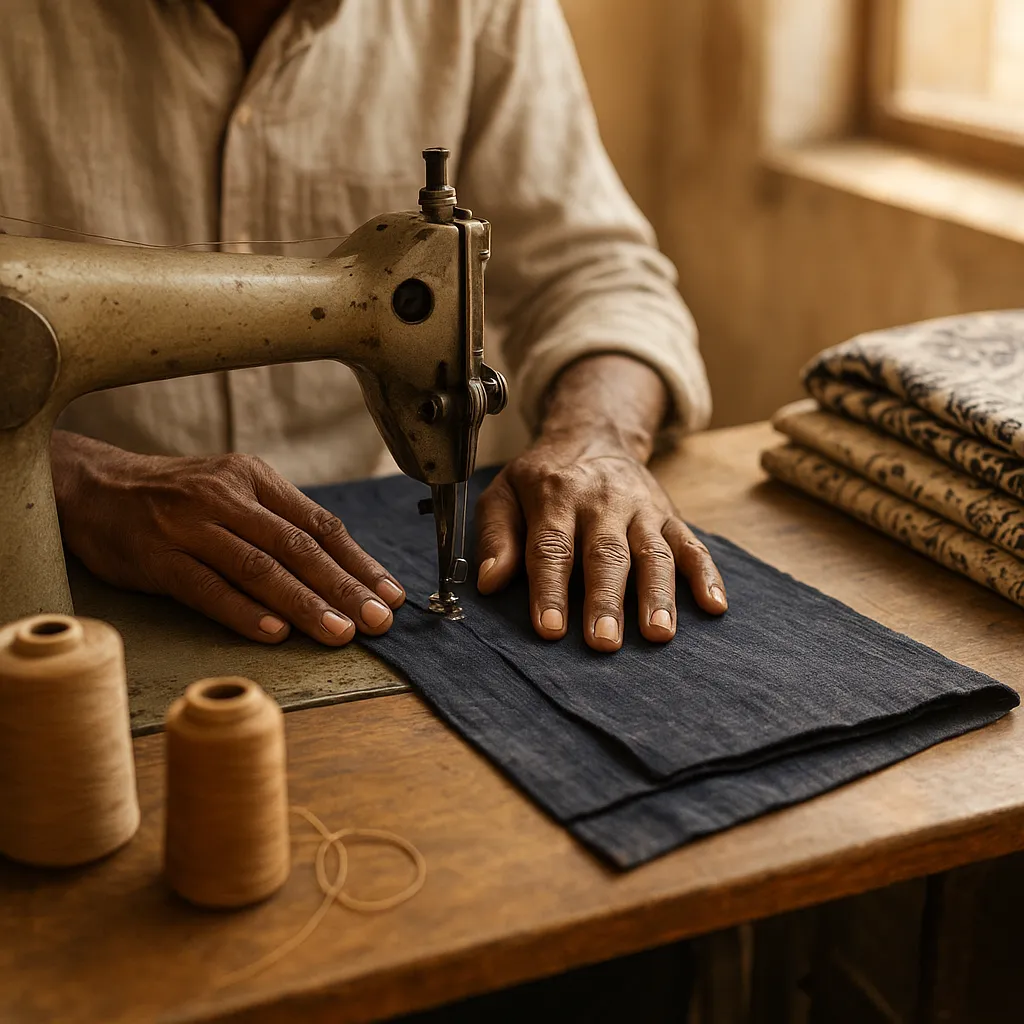
The production approach Kardo calls ONExONE is the clearest expression of its values. Instead of splitting a garment across a production line, a single tailor cuts, sews and finishes each piece from start to finish. The result is slower and less scalable than conventional manufacturing, but it keeps responsibility visible — both for the maker and for the customer who reads the name on the label.
This sits alongside a textile palette that spans naturally dyed handloom, block printing, ikat, natural indigo denim, shibori and chikankari embroidery. Rather than treating these techniques as heritage decoration, Kardo works them into workwear and tailoring shapes that fit into a modern wardrobe.
Built for international shelves
Kher set his sights on buyers abroad from the beginning. An early meeting in Las Vegas led to a partnership with Peregrine Showroom, which helped establish the brand’s wholesale business overseas. Collaborations have extended its reach further, including capsule collections with Monitaly and W’menswear as well as with Indo Warehouse co-founder Kunal Merchant.
Today Kardo’s stockist list runs to close to 130 retail locations across 16 markets, among them the United States, the United Kingdom, France, Japan, Canada and Germany. Retail partners include Mr Porter, END. Clothing, Beams, Merci and Mohawk General Store. In the Netherlands, shoppers can find the label at DAENS in Utrecht and X21 in Rotterdam.
What it costs
Pricing on Kardo’s own webshop places the brand in the accessible-premium bracket. The Luis corduroy shirt is listed at 175 US dollars, the Damien 2.0 shirt in JAC23 fabric at 200 dollars and the Martin embroidered shirt at 250 dollars. The Ronen shirt spans a range of fabrics and costs between 152 and 378 euros — roughly 170 to 425 dollars — depending on the cloth chosen.
Prices shown include taxes, and the brand states that it covers import duties on international orders, which simplifies buying from abroad.
A Delhi flagship and a Paris runway slot
In November 2025 Kardo opened its first own store, in Lodhi Colony Market in New Delhi. The choice of location was deliberate. Kher had previously scouted a site in London but ultimately opted for the Indian capital for the brand’s first flagship, saying simply that he was betting on India.
International visibility has continued alongside that homegrown footing. In January 2026 Kher presented the brand’s autumn/winter collection in Paris during Men’s Fashion Week.
Daftar: autumn/winter 2026
The latest collection takes Indian office culture in the decades following independence as its theme. Named Daftar, it draws on the everyday working wardrobe of a newly independent nation and reinterprets it through Kardo’s craft-led lens. The line also introduces footwear developed in collaboration with the English shoemaker Sanders and with Paiwand — a first step beyond clothing.
The collection follows the Delhi store opening and marks a period in which the brand’s Indian identity and its international ambitions are being pursued in parallel.
A steady rhythm
Kardo releases two main collections each year, spring/summer and autumn/winter, and has not announced further expansion plans since the Delhi store. For now the strategy is one of balance: a growing presence in the Indian market on one side, an established wholesale network across Europe, North America and Asia on the other, and a production model that keeps the people behind each garment in view.
That combination — traditional textile skill, contemporary cutting and traceable making — is what positions Kardo at the intersection of craft and modern menswear, rather than in either camp alone.