Linen
Five Designers Rewriting the Rules of Linen on the Catwalk
How five emerging designers at the 2026 Hyères Festival transformed European flax-linen into sculptural, waxed and upcycled fashion far beyond summer shorts.
Linen is having a moment, but not the one most of us expected. At the 2026 International Festival of Fashion, Photography and Accessories in Hyères, five finalists took fabric supplied by the Alliance for European Flax-Linen & Hemp and pushed it well past the familiar territory of summer shorts and relaxed holiday shirts. Two of those designers went on to collect awards. All five treated the fibre as a starting point for genuine material research rather than a box to tick on a sustainability checklist.
What unites their work is a shared curiosity about what linen does rather than simply what it stands for. The designers were drawn to its sculptural qualities, its varied textures, its structural strength and the way it behaves when combined with unexpected materials. Some showed their linen pieces on the catwalk at the Forum du Casino; others were introduced through the showroom at the Villa Noailles, where visitors could examine the garments up close. Between them, the five demonstrate how a fibre grown across Europe, from Brittany through to the Netherlands, can move in radically different directions.
Brais Albor Rodriguez: linen with a rugged, raw edge
Before encountering the Alliance, Brais Albor Rodriguez mostly associated linen with lightweight summer clothing. The festival introduced him to finishes and behaviours he had not encountered before, even though the fibre already carried personal weight: raised in Galicia in northern Spain and now based in Milan, he grew up with linen woven into regional costume.
His response was to use linen yarn in several distinct ways. One jacket in pure linen takes on the dense, felted appearance of boiled wool. Elsewhere he developed a paper-like textile, experimented with waxed linen and used torn, blended linen offcuts to trim a coat made from recycled fur. The result challenges received ideas about how the fabric should look and behave. Albor Rodriguez received the 2026 City of Hyères Public Prize as well as a special jury mention.
Dieter Vlasich Obermann: where plant fibre meets the human body
Dieter Vlasich Obermann, who grew up in Yucatán in Mexico, resists reading linen purely through an environmental lens. He acknowledges the case for the fibre, from sustainable cultivation to durability and temperature regulation, but his interest lies in its wider creative reach.
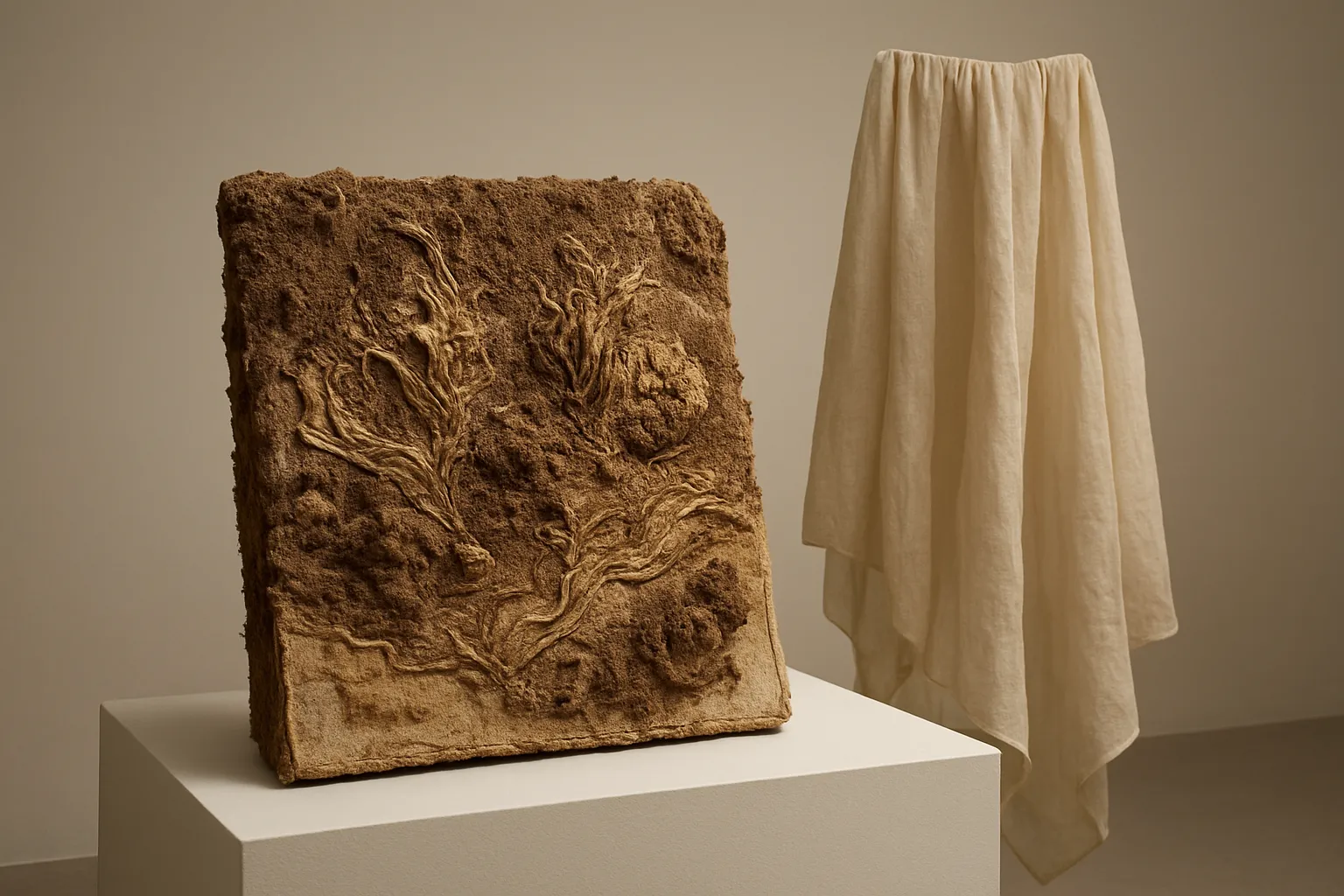
His experimental bust, built from soil and linen yarn, embodies what he calls a regenerative approach, and sits alongside a skirt in linen voile. Working with several metres of fabric, he set about creating reliefs and surface textures rather than conventional garments. Flax fibres are fixed onto embroidered bases, while human hair is incorporated into some surfaces to suggest the interdependence of people and the natural world. To bind certain fibres, he turned to chia seeds as a natural adhesive.
That spirit of textile experimentation earned Vlasich Obermann the Métiers d’Art Prize, awarded for the strongest collaboration between a festival finalist and one of the Maisons d’Art within the Chanel ecosystem.
Jennifer Milleder: Austrian dress, reinterpreted in local cloth
Jennifer Milleder, a Vienna-based Austrian designer, had little idea of how broad the world of linen textiles could be until the Alliance made its fabrics available to the finalists. Through that process she also learned that Austrian suppliers numbered among the organisation’s partners.
Because her six looks rework traditional Austrian dress, she deliberately chose a domestic supplier to tighten the connection between where her materials come from and what her collection is saying. The jacquard she selected came from Rechberger Weberei, an Austrian weaver and Alliance member. She used it for wide-leg trousers with generous volume, and paired it with fabrics carrying regional motifs for a sculptural coat.
Farnia Salim: a proud Iranian identity in neutral tones
Farnia Salim, an Iranian designer based in Milan, already knew linen well but had little awareness of the Alliance. She came across its fabrics at the Milano Unica trade show and was drawn immediately to the natural shades on offer, particularly cream and beige, which sit comfortably within her established colour palette.
Her six looks set out to resist one-dimensional representations of Iran. She wants to express a cultural identity that is proud and joyful while weaving in Western references, holding the two in balance rather than letting either dominate. That balancing act finds a textile equivalent in a linen-blend fabric with a subtle reddish undertone that keeps the overall palette neutral.
Loïs Cousin: taking linen from the countryside to the city
Loïs Cousin had worked with linen before, but mostly in the form of warm, often yellowish canvases. Discovering waxed linen opened up a different aesthetic entirely.
The centrepiece of his experiments is a pair of wide-leg linen trousers coated in a synthetic material, a finish that changes how the fabric feels, how it falls and how it catches the light. The waxed linen, supplied for the competition by Alliance partner Linea S, sits in contrast with the eco-design principles usually attached to the fibre, yet it delivers exactly the look Cousin was after.
The trousers also incorporate repurposed curtain heading tape. Cousin removed the cords, stitched the bands onto the garment and gathered the fabric to build volume. That upcycling instinct reflects his affection for weathered buildings, concrete surfaces and the urban environment, and his wish to spotlight the culture and energy of the suburbs rather than repeat tired stereotypes about them.
One fibre, five directions
Seen together, these five collections challenge the assumption that linen comes with a fixed identity. Albor Rodriguez gives it a raw, almost brutalist weight. Vlasich Obermann treats it as a bridge between the cultivated and the bodily. Milleder roots it in regional craft and local supply chains. Salim uses its natural hues to carry a cultural argument. Cousin takes it into the city through wax finishes and salvaged trims.
What connects them is a willingness to work with the fibre’s properties rather than against them: its strength, its texture, its capacity to hold structure, and its openness to being blended, coated, torn or bound. For designers starting out, the lesson is straightforward. A material with a long history does not have to be used in a predictable way. Give emerging talent a few metres of cloth and the right questions, and linen can look entirely new.