Sustainable Fashion
Fashion Farm: Growing Clothes on Dutch Soil
Discover how the Fashion Farm in Welsum is reconnecting fashion with nature by growing flax, woad and raising sheep for local textiles.
A farm where fashion begins with a seed
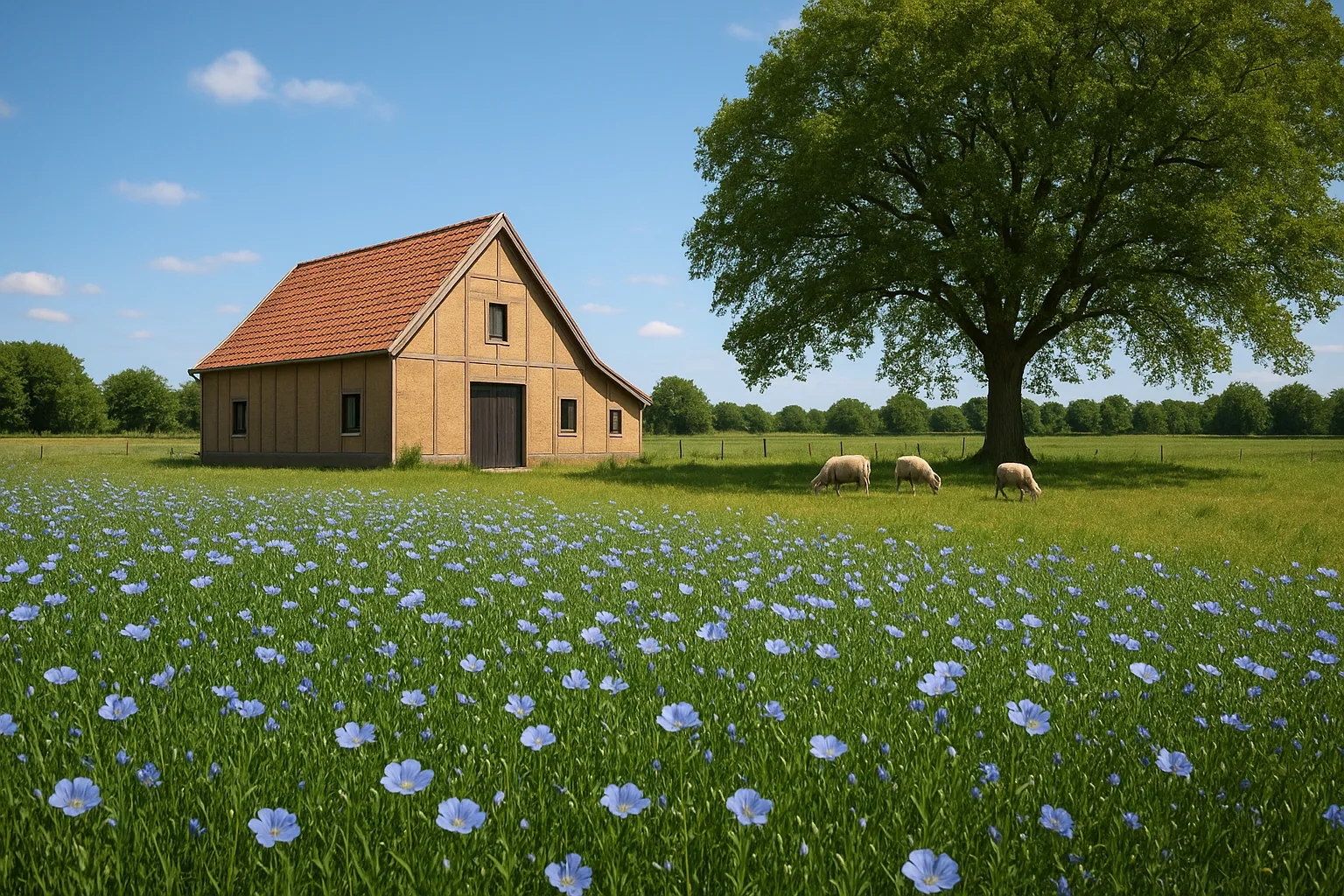
What if a garment started not with a sketch, but with a seed? That question lies at the heart of the Fashion Farm in Welsum, a small village on the left bank of the IJssel River in the municipality of Olst-Wijhe. Here, on 1.1 hectares of land, a former Rotterdam resident has set out to explore what happens when you reduce the distance between fashion and nature.
In 2023, Joline Jolink moved from Rotterdam to a farm in Overijssel – not to become a farmer, but to investigate how fashion might reconnect with its origins. That research was given a name and a home: the Fashion Farm. Since then, the site has become a living study into local fibres, natural dyes and regenerative production.
Walking around the Fashion Farm, you will not find a traditional fashion supply chain. Instead, you see flax growing in the field and woad among the vegetables in the kitchen garden. Sheep’s wool is sorted and processed, colour emerges from walnuts, and people from the local community work side by side with contacts from the fashion world during ‘Volunteer Friday’. You see weaving experiments from the first flax harvest. Here, a garment begins not with a design sketch, but with a seed.
From flax to linen: a lesson in slowing down
In spring, flax is sown at the Fashion Farm – one of Europe’s oldest textile crops. Months later, it is harvested, retted, processed and ultimately spun into yarn. This process reveals just how much knowledge, time and attention lie behind something as seemingly simple as linen fabric. Since April 2024, the journey to create a home-grown linen garment has been a lesson in slowing down. Every step is celebrated, such as the first Welsum linen thread incorporated into the Lin jacket.
Elsewhere on the property grows woad, a historic dye plant used for centuries to colour textiles blue. The leaves are harvested and processed into natural pigment. What starts as a green plant ultimately ends up as a deep blue hue in a garment – reflected in the magical colour gradient of the Gertrude jumper. Named after a favourite chicken, the jumper tells the story of local wool, dye plants and collaborations. It raises the question of what value we attach to these elements. In 2024, the Gertrude jumper began a tour of fashion exhibitions, clothing libraries, radio and television, and from 22 October it will capture the hearts of visitors at the Zuiderzeemuseum for ten months. The large walnut tree at the Fashion Farm also provides colour, which was used to dye the Rona knitted vest.
A studio built from natural and recycled materials
The philosophy of designing with a love for nature extends to the renovation of the former chicken shed (400 square metres) on the property. It now serves as a design studio, workshop and knowledge centre for local textiles. The renovation demonstrates that craftsmanship, aesthetics and responsibility transcend disciplines and reinforce one another. Together with architectural firm la-di-da, bio-building contractor Dijkhuis, various experts and a dedicated group of volunteers, a building has been created entirely from natural and recycled materials. These range from shells and cellulose for insulation to a facade of hemp fibre panels and a unique rammed earth floor.
Rammed earth: a floor of nearly 50,000 kilograms of loam
A loam floor seems like a logical choice: earthy, sustainable and natural. However, a surface area of 400 square metres had never been achieved in Europe before. The building contains nearly 50,000 kilograms of loam – a natural material based on clay and sand that was built up, compacted and levelled layer by layer. Italian loam expert Tomasso Venturini supervised the process, sharing his knowledge and experience with architecture students and volunteers. In turn, all these people were indispensable in pooling their strength to literally and figuratively put the material in its place. Together, they helped lay the foundation for a regenerative future. In this way, the story of a new fashion system is being built step by step.
Bringing craftsmanship back to Dutch soil
What all these experiments have in common is that they make Dutch craftsmanship visible. They show how many steps exist between raw material and wardrobe, as well as how much skill, knowledge and collaboration are required. After all, the Fashion Farm is not only about materials. It is also about people who each bring their own expertise and collectively explore what an alternative way of producing could look like.
The art of asking questions
The Fashion Farm is not a place where all the answers have been found. It is a place where questions are asked and learning happens. How local can a garment become? Which raw materials can grow on Dutch soil? How do we restore knowledge that has been largely lost? Finally, what does fashion look like when it once again becomes part of a living ecosystem?
Through workshops, masterclasses and guided tours, the Fashion Farm makes visible what normally happens behind the scenes. It shares knowledge about local fibres, natural dyes, craftsmanship and regenerative production, inviting others to reconnect with what they wear. The Fashion Farm is therefore not just a farm, design studio or knowledge centre. It is a living study into what fashion looks like when you make it part of life itself once again.