Counterfeiting
EU Counterfeit Seizures Hit Record 196 Million Items
EU authorities detained a record 196 million counterfeit items in 2025, worth an estimated €6.3 billion. We break down the products, countries and trends behind the surge.
A Record Year for Interceptions
Customs officers and market surveillance authorities across the European Union detained more than 196 million counterfeit items in 2025, with an estimated value of €6.3 billion. It is the highest number of detentions ever logged by EU enforcement bodies, and the scale of the increase is striking: 67 per cent more than in 2024 and 29 per cent above the previous peak reached in 2023. The figures cover seizures at the EU’s external borders as well as operations within the internal market, giving a fuller picture of how counterfeit trade moves once goods are already inside the bloc.
What Is Being Seized
The breakdown by product category reveals a great deal about how counterfeiters operate. Recorded CDs and DVDs remained the single most frequently detained category in 2025, making up almost 30 per cent of all detentions. This covers music and film releases, television box sets, retro video games and application software — a broad category that reflects how much digital and entertainment content is still distributed on physical discs.
Toys accounted for close to one in five seized items, a category that carries particular concern given that counterfeit toys often bypass the safety testing required of legitimate manufacturers.
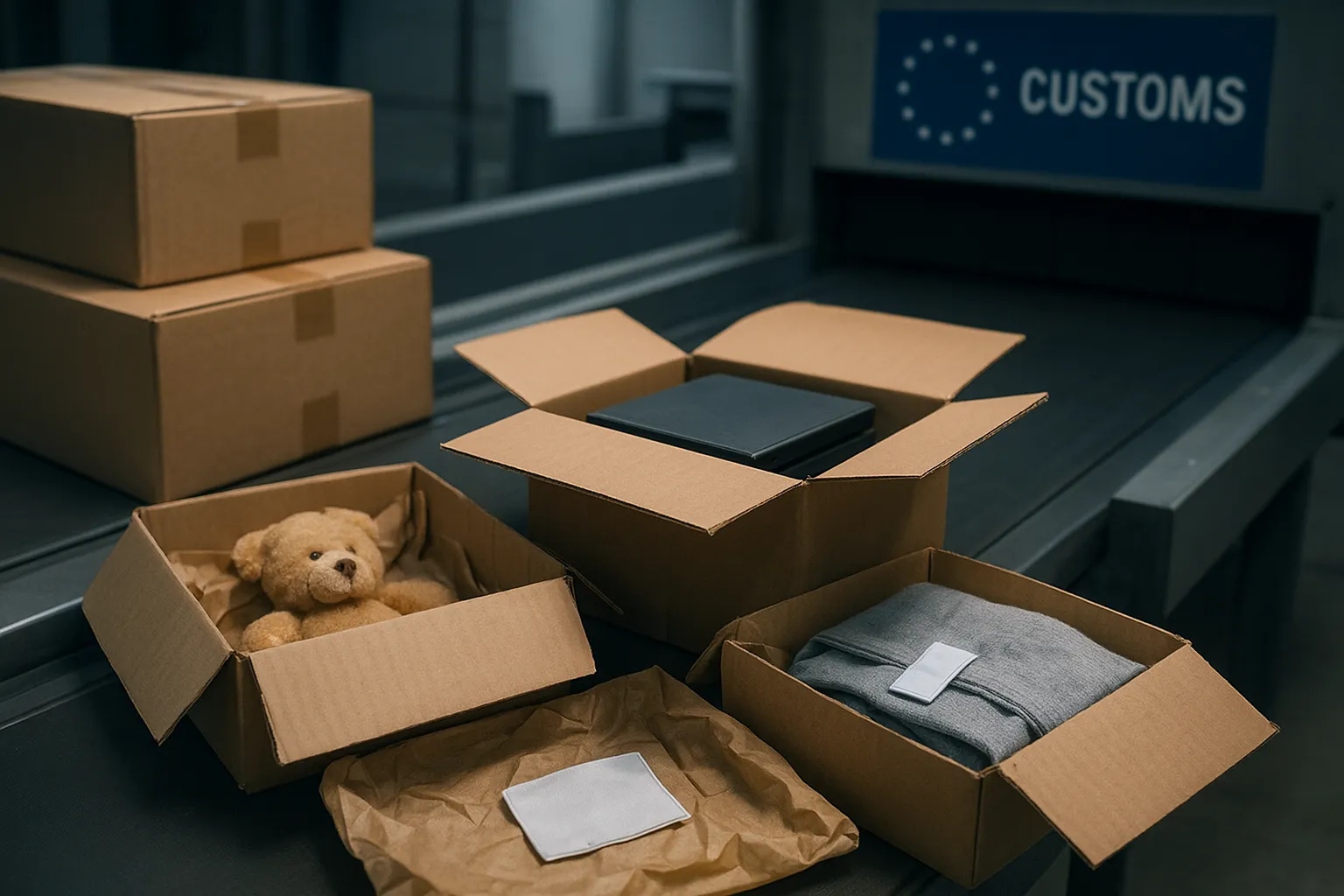
A revealing detail is the high volume of intercepted labels, tags and stickers. On their own these items may look trivial, but their presence in the data points to a specific method: counterfeiters shipping plain goods into the EU and adding branding once the products are inside, so that the finished counterfeit is assembled close to its final market. This practice fragments the supply chain and makes it harder for customs to identify infringing goods at the point of entry.
Other frequently detained categories include games, including electronic consoles, as well as clothing and cigarettes — the latter covering both conventional tobacco products and e-cigarettes and vaping devices.
Where the Seizures Happen
Inside the internal market, Italy stood far ahead of its neighbours, responsible for more than 70 per cent of all detentions. France followed at 6.2 per cent and the Netherlands at 4.8 per cent. The concentration in one member state reflects both the scale of Italy’s domestic market for branded goods and the intensity of its enforcement activity.
For small Italian firms, the problem is felt acutely. Research by the national confederation representing craft businesses and small and medium-sized enterprises has underlined how deeply smaller operators perceive counterfeiting as a threat — not only to their competitive position but to the perceived quality and value associated with Italian-made products. For a business built on reputation and craftsmanship, a convincing fake does damage that goes well beyond the lost sale itself.
At the EU’s external borders, the picture looks different. Romania handled 43 per cent of detained items, followed by Bulgaria and Italy. Measured by estimated economic value rather than item count, Spain accounted for more than half of the total value of intercepted counterfeit goods, with Germany next.
Trademarks Lead the Infringement Breakdown
When looked at by the type of intellectual property right involved, trademarks were the most commonly infringed, present in 57 per cent of seized goods. Copyright followed at 43 per cent, while design rights featured in 7 per cent of cases. Goods frequently infringe more than one right at once, so these shares overlap rather than summing to 100 per cent.
Why Detection Is Getting Harder
Behind the record numbers sits a structurally more difficult enforcement problem. The volume of goods entering the EU keeps climbing. Supply chains are increasingly fragmented, with components and finished products crossing multiple jurisdictions before reaching a consumer. Transport methods are more varied than ever, mixing sea freight, air cargo, road haulage and small-parcel delivery. And the growth of e-commerce means that a single shipment may consist of hundreds of individually addressed packets, each too small to justify the cost of a full inspection.
That combination — scale, dispersal and velocity — is precisely what makes counterfeit goods harder to spot and intercept. Enforcement agencies are not dealing with a few large consignments but with a continuous flow of small, mixed and often deliberately mislabelled shipments. The 2025 figures, while a testament to the work of customs authorities, also illustrate how much infringing material is being produced and moved in the first place.
For retailers, brand owners and consumers alike, the message is that the counterfeit economy is not a niche problem. It touches entertainment, toys, clothing, tobacco alternatives and digital software, and it adapts quickly to whatever enforcement authorities do next.