Sports Retail
AI in Sports Retail: Will Shoppers Trust an Agent or a Human?
Sports retail leaders from Amazon, Intersport and New Balance debate whether AI agents will replace human expertise in-store, and why trust still matters for high-value purchases.
The debate: AI versus human interaction in sports retail
As artificial intelligence becomes more integrated into shopping experiences, a central question emerges: will consumers trust an AI agent or a human with their next sports purchase? Industry leaders from Amazon, Intersport and New Balance tackled this at the ISPO Summit in Amsterdam, during a panel titled “The Future of Retail: Where Consumer Insight Meets Intelligent Commerce.” The discussion brought together Avi Samtani, managing director and Europe GM at Amazon Sports; Tom Foley, CEO of Intersport International Corporation; and Ger Wright, VP sales EMEA at New Balance. Moderated by Yasmin Dufournet, head of consumer insights, the panel converged on one point: AI will reshape how people shop for sporting goods, but it won’t replace physical stores or human expertise anytime soon—especially for high-value, emotionally driven purchases.
The current limits of AI agents
When asked whether he would rather buy through an AI agent or a human, Samtani emphasised that his loyalty lies with the customer experience, regardless of how it’s delivered. He noted that many multi-purpose agents—those that scrape the internet to make purchasing decisions—are not yet up to standard. “Today, a lot of multi-purpose agents just don’t make the cut,” he said. “I don’t think we’re there yet. I do think agents within retailers are a lot better.” He added that while he would choose an excellent agent, such agents are “few and far between today.” The problem, according to Samtani, is that these general agents struggle to secure the right price and inventory levels, resulting in a subpar customer experience. However, he anticipates a significant shift: “Looking five years forward, I think we’re probably having a very different conversation.”
Why human expertise still matters
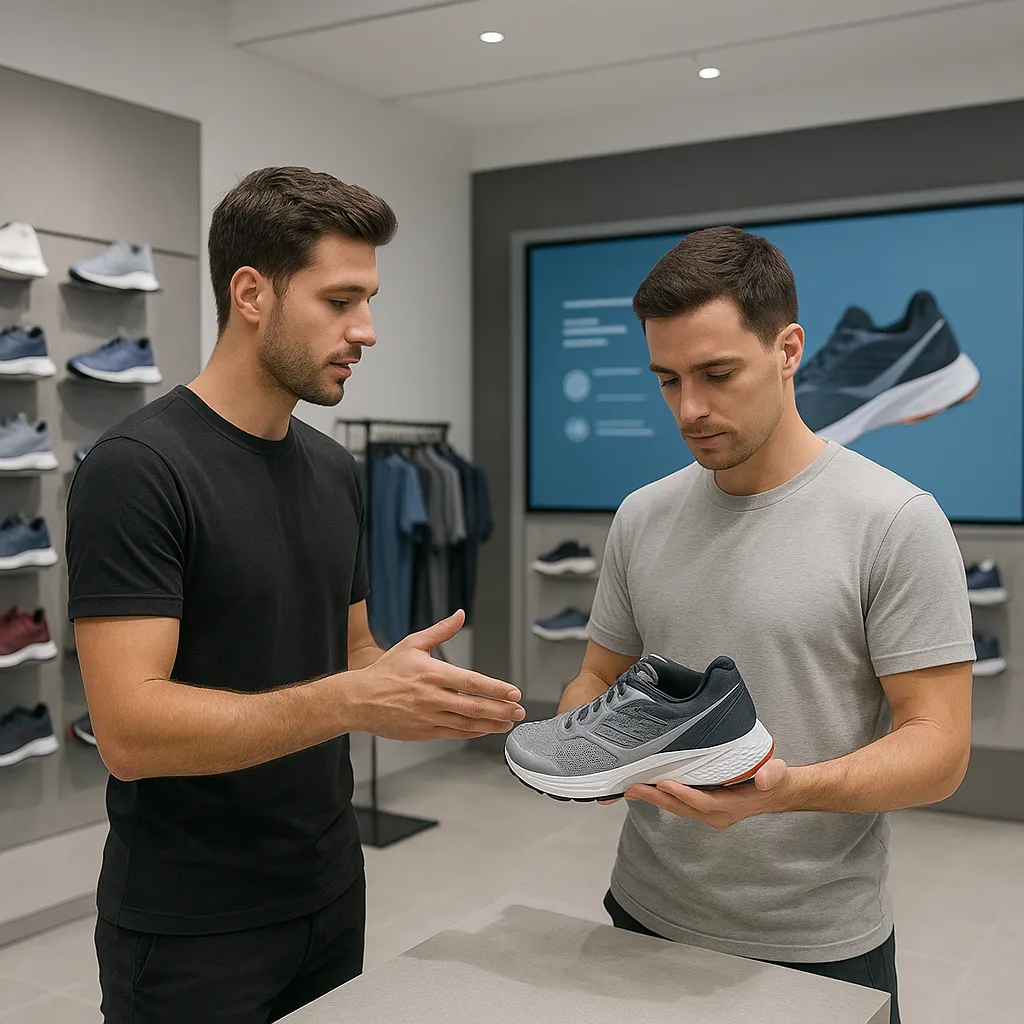
Foley and Wright both favoured the human touch, at least for now. Foley highlighted Intersport’s human-intensive approach, noting that the company operates over 5,000 stores and continues to open new ones successfully despite the available technology. He attributed this to the emotive nature of sport: “Because of the emotive element of sport, there’s a need to talk to a human and engage with a human. I don’t think that will ever go away, even with an excellent agent.” Wright echoed this sentiment, pointing out that when spending £250 on a running shoe, customers want to touch and feel the product. “We know sport is very emotional,” she said. “It’s not just about going in and making a purchase. The consumer is usually buying into something, buying into a goal or something they want to achieve.” She described her ideal store experience: “I want to go to a store. I want to be served by a great store athlete. I want to see different options. I want to be able to try them on.”
Brands must enrich AI with data
Wright also stressed that brands have a role in building trust in AI agents. “From a brand perspective, we can really help the agent by giving them rich data, to be able to serve the consumer in a smarter, faster way in the future,” she said. “The data needs to be rich, and we need to share a lot of data, but if we can do that, I believe the agent can really help the journey.” This could transform the store visit rather than eliminate it. “The next time I come into a store, I know the brand I want, I probably know the pair of sneakers I want and how much I’m going to be paying, because I will have been served that by the agent,” she explained.
Physical stores remain valid
Addressing whether trained agents could spell the end of physical retail, Foley pointed to predictions made during the pandemic. “There was a lot of commentary that consumer behaviour is going to change forever, and that people will shop online and that bricks and mortar was dead,” he said. “And then shortly afterwards, people went back to going to stores.” He noted that AI is already making shoppers better informed but not necessarily more decisive. An Intersport test asked an AI tool to recommend three tennis rackets for an intermediate baseline player. “It recommended three rackets to us. But I wouldn’t purchase based on those recommendations,” Foley said. “I think you still need that validation, and you still need that confirmation, and you go into the stores to get that.” He cited a statistic that only 22% of shoppers have made up their minds before entering a store. “That means that the relationship between the store staff, managers, owners and the consumer is becoming more important, because that trust element is really, really important,” he said. “I really think that the role of bricks and mortar will evolve, but it will still be as valid in five years’ time as it is today.” Wright added that brands and retailers are investing in elevated store experiences, with many organising running events and building communities. Foley agreed, especially outside major cities: “In towns and in areas where the sports shop is close to where sport is being played, close to the schools, close to the clubs, close to the facilities, I think the sports store has a real role in the fabric of that community.”
The tactile reality of online shopping
Samtani challenged the notion that online shopping lacks a tactile element. “I think it’s a misconception that you don’t touch and feel when you buy online,” he said. “When you buy online, you’re not making your purchase decision at the point of checkout. You’re making the purchase decision when you decide to keep the product after it’s delivered to your doorstep. And at that point, you are touching and feeling the product.” He predicted that AI will “touch every single customer journey going forward,” but use cases will diverge. Agents will handle repetitive replenishment purchases, while discovery remains human-led. “I don’t think agents are necessarily going to take over discovery,” he said. “I think agents are going to help you get to a point of information where you can then make your own decisions.” His forecast for the next five years: “It’s going to be humans with agents.” Dufournet shared her research finding that “the more expensive the product, the more you want a human to advise you in sports.” In winter sports, for instance, consumers buying ski boots and bindings preferred to talk to someone, while lower-value purchases were more readily left to AI.
AI behind the scenes
Wright suggested that AI could also transform internal operations, including buying. “All of that information is in these buyers’ heads. I suppose the question we need to be asking is, how can we get that information out of buyers’ heads and train the AI?” she said. Agents could handle forecasting and planning in the background, and “maybe in the future, they can create assortments.” Samtani added that companies will soon be “running thousands of agents,” which will cut costs across operations. Those savings, he said, “can be invested back into creating these connections with customers,” including in physical retail moments.
The panel made one thing clear: while AI will undoubtedly change the retail landscape, the human touch—especially in sport—remains irreplaceable for now.